
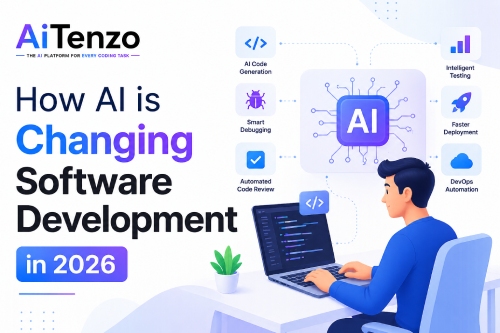
From Tooling to Teammate
The most visible change is the transition from static tools to context-aware AI systems. Modern AI coding platforms don’t just autocomplete lines; they ingest repository context, dependency graphs, commit history, and even product requirements to generate meaningful code. This changes the interaction model:
Developers describe intent; AI proposes implementations
Code generation is iterative and conversational
Refactoring is suggested proactively, not reactively
Instead of writing every function from scratch, developers are increasingly curating, validating, and guiding AI-generated output.
AI-Driven Code Generation at Scale
Code generation in 2026 is no longer limited to snippets. AI systems can scaffold entire modules, integrate APIs, and maintain architectural consistency. With improved reasoning capabilities, they can:
Translate product requirements into structured code
Generate boilerplate across frameworks instantly
Maintain naming conventions and design patterns across files
This dramatically reduces time spent on repetitive tasks. The productivity gain is not just speed—it’s consistency and reduced cognitive load.
Debugging Is Becoming Predictive
Traditional debugging is reactive: something breaks, then you investigate. AI flips this model toward predictive debugging.
Modern systems analyze code patterns, runtime behavior, and historical bugs to identify potential failures before they occur. Instead of just highlighting syntax errors, AI can:
Detect logical inconsistencies across modules
Suggest fixes with explanations
Simulate edge cases that developers might overlook
The result is a measurable drop in defect rates and a shift from firefighting to preventative engineering.
Automated Code Review and Quality Enforcement
Code reviews are essential but time-consuming. In 2026, AI acts as a first-line reviewer, enforcing quality standards before human review even begins.
AI-powered review systems can:
Flag anti-patterns and security vulnerabilities
Ensure adherence to coding standards
Suggest performance optimizations
This doesn’t eliminate human review—it elevates it. Developers spend less time on minor issues and more on architecture, scalability, and business logic.
Intelligent DevOps and Deployment Pipelines
AI is also reshaping DevOps. CI/CD pipelines are becoming self-optimizing systems:
Build failures are diagnosed automatically
Deployment strategies are adjusted based on risk signals
Infrastructure scaling decisions are made dynamically
AI monitors logs, traces, and metrics in real time, enabling faster incident response and reduced downtime. The boundary between development and operations continues to blur.
Natural Language as a Programming Interface
One of the most transformative shifts is the rise of natural language-driven development. Developers can now describe features in plain English and receive structured implementations.
This lowers the barrier to entry and accelerates prototyping:
Product managers can contribute directly to technical workflows
Non-developers can build functional prototypes
Developers can focus on refining rather than drafting
However, this also introduces new responsibilities—ensuring that generated code is secure, efficient, and maintainable.
AI-Augmented Learning and Onboarding
For junior developers, AI acts as a real-time mentor. Instead of searching documentation or forums, they receive contextual guidance inside their workflow.
AI can:
Explain complex code in simple terms
Suggest best practices while coding
Provide instant feedback on mistakes
This shortens the learning curve significantly and enables faster onboarding for teams.
Security Is Becoming Proactive
Security is no longer an afterthought. AI integrates directly into the development process to identify vulnerabilities early.
Modern AI systems:
Scan for insecure dependencies
Detect potential injection points
Recommend secure coding patterns
By embedding security into everyday workflows, teams reduce the risk of costly post-deployment fixes.
The Shift in Developer Skill Sets
As AI takes over repetitive and mechanical tasks, the role of developers is evolving. The most valuable skills in 2026 are not just technical—they’re strategic and architectural.
Developers now need to:
Define clear problem statements for AI systems
Validate and refine AI-generated outputs
Design scalable and maintainable architectures
In other words, the role is shifting from “code writer” to system thinker and orchestrator.
Challenges and Trade-offs
Despite the advantages, AI-driven development introduces new complexities:
Over-reliance on AI can lead to shallow understanding
Generated code may require rigorous validation
Data privacy and code ownership concerns remain critical
Teams need governance—clear guidelines on when and how AI should be used, along with strong review processes.
Where Platforms Like AiTenzo Fit In
The emergence of unified AI platforms is addressing fragmentation in the developer toolchain. Instead of using separate tools for debugging, generation, optimization, and automation, platforms like AiTenzo consolidate these capabilities into a single workflow.
This integration matters because:
Context is preserved across tasks
Switching costs between tools are eliminated
Productivity compounds across the development cycle
The advantage is not just efficiency—it’s cohesion in how development is executed.
AI in 2026 is not replacing developers; it’s redefining how they work. The teams that adapt are not just faster—they’re building better systems with fewer constraints, leveraging AI as a force multiplier rather than a shortcut.