Artificial Intelligence is transforming software development faster than any tooling revolution in recent decades. AI can now generate functions, debug applications, optimize code, write documentation, and even automate deployments. As these capabilities improve, one question continues to dominate discussions across the developer community:
Will AI replace human programmers?
The reality is more nuanced. AI is changing how software is built, but human developers still play the central role in architecture, creativity, strategic thinking, and decision-making. The future is not AI versus developers—it’s developers who understand AI versus those who ignore it.
Understanding the strengths and limitations of both AI coding systems and human programmers is becoming essential in 2026.
The Rise of AI-Powered Development
AI coding platforms have evolved far beyond autocomplete. Modern systems can:
- Generate production-ready code
- Suggest architecture patterns
- Detect bugs proactively
- Refactor legacy code
- Explain complex logic in plain language
This has dramatically accelerated development cycles. Tasks that once required hours can now be completed in minutes.
Platforms like AiTenzo are helping developers automate repetitive workflows while improving speed and productivity across the development lifecycle.
But speed alone does not define great software engineering.
What AI Coding Does Extremely Well
AI excels in areas that involve:
- Pattern recognition
- Repetition
- Large-scale code analysis
- Predictive suggestions
Because AI systems are trained on massive datasets, they can identify common structures and produce accurate outputs quickly.
1. Rapid Code Generation
AI can generate:
- APIs
- CRUD systems
- Boilerplate code
- UI components
- Database models
This significantly reduces development time for routine implementation tasks.
For example, a developer can describe a feature in natural language and receive a functional codebase draft within seconds.
2. Faster Debugging
AI systems are becoming highly effective at:
- Identifying syntax issues
- Detecting logical errors
- Suggesting optimized fixes
- Tracing dependency conflicts
Instead of manually searching through stack traces, developers can now receive contextual debugging assistance instantly.
3. Automation of Repetitive Tasks
Developers spend a surprising amount of time on repetitive work:
- Writing similar functions
- Formatting code
- Creating tests
- Updating dependencies
AI automates these low-value tasks, allowing developers to focus on higher-level engineering challenges.
4. Code Optimization
AI tools can analyze performance bottlenecks and suggest:
- Better algorithms
- Cleaner structures
- Memory optimizations
- Faster queries
This helps improve application performance while reducing technical debt.
Where Human Developers Still Dominate
Despite its capabilities, AI still lacks several critical aspects of real-world software engineering.
Human developers bring:
- Creativity
- Product intuition
- Business understanding
- Ethical reasoning
- Architectural thinking
These are areas where AI remains fundamentally limited.
1. Problem Solving and Innovation
AI can generate solutions based on existing patterns, but it does not truly innovate.
Humans:
- Invent new systems
- Design unique architectures
- Solve ambiguous business problems
- Create novel user experiences
The best software products are rarely built from predictable patterns alone.
2. Understanding Business Context
A major limitation of AI is contextual understanding.
AI may generate technically correct code while completely misunderstanding:
- User expectations
- Business goals
- Scalability requirements
- Operational constraints
Human developers bridge the gap between technology and business value.
3. System Architecture Decisions
Large-scale systems require strategic planning:
- Microservices vs monoliths
- Database selection
- Security architecture
- Scalability planning
These decisions involve trade-offs, experience, and long-term thinking that AI cannot independently evaluate with full reliability.
4. Creativity in UI/UX Development
AI can generate interfaces quickly, but human creativity remains essential for:
- User-centered design
- Emotional engagement
- Brand identity
- Product differentiation
Exceptional products are built through empathy and experience—not just generated layouts.
The Biggest Misconception About AI Coding
Many developers fear AI because they assume coding equals typing syntax.
In reality, professional software engineering involves:
- Strategic thinking
- Communication
- Collaboration
- Product reasoning
- Infrastructure planning
AI reduces mechanical work, but it does not replace engineering judgment.
The developers most at risk are not those who use AI—they are the ones who refuse to adapt to AI-assisted workflows.
The New Role of Developers in 2026
The role of developers is evolving rapidly.
Instead of spending most of their time manually writing repetitive code, developers are becoming:
- AI orchestrators
- System designers
- Workflow architects
- Product-focused engineers
This shift increases the importance of:
- Critical thinking
- AI prompt engineering
- Code validation
- Architectural oversight
Developers are moving up the abstraction layer.
AI-Generated Code Still Requires Human Validation
One dangerous assumption is that AI-generated code is always correct.
AI systems can still produce:
- Insecure implementations
- Inefficient logic
- Outdated patterns
- Hallucinated functions
- Broken integrations
Human review remains critical.
The most effective workflow is:
- AI generates
- Human validates
- AI optimizes
- Human approves
This collaboration produces the best outcomes.
AI Will Transform Junior Developer Workflows
Junior developers are experiencing the biggest productivity boost from AI.
AI can:
- Explain concepts instantly
- Suggest best practices
- Detect beginner mistakes
- Accelerate learning
This shortens onboarding time dramatically.
However, there is also a risk:
Developers who rely entirely on AI without understanding fundamentals may struggle with:
- Debugging complex systems
- Architecture decisions
- Performance optimization
Foundational knowledge still matters.
Enterprise Development Is Becoming AI-Augmented
Companies are increasingly integrating AI into:
- Internal developer tools
- DevOps pipelines
- Security scanning
- Testing systems
- Documentation workflows
This is creating hybrid environments where human developers and AI systems collaborate continuously.
Organizations adopting AI-assisted development are seeing:
- Faster release cycles
- Reduced development costs
- Improved code consistency
- Better productivity
The competitive advantage is becoming difficult to ignore.
The Future Is Collaborative, Not Competitive
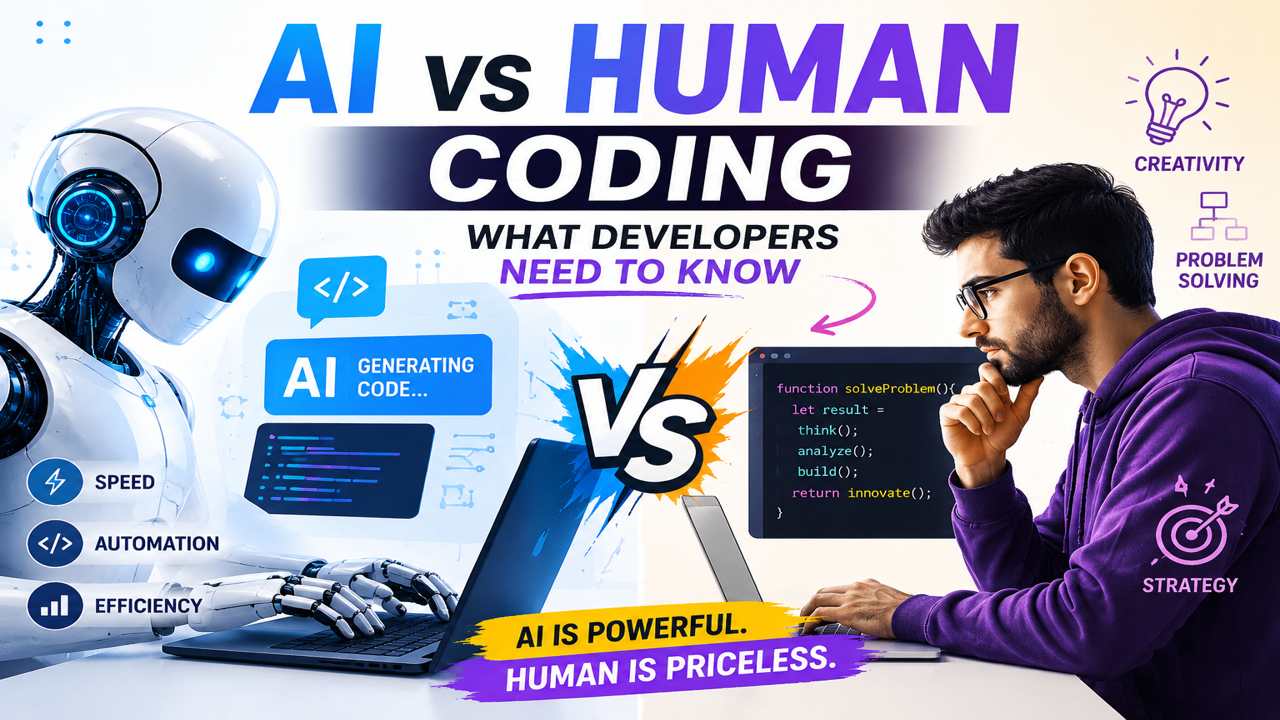
The narrative of “AI vs Human Coding” creates unnecessary fear. The actual future looks more like:
- AI handling repetitive execution
- Humans handling strategy and creativity
AI is becoming a force multiplier for developers—not a complete replacement.
The developers who thrive in the coming years will be those who:
- Learn AI-assisted workflows
- Adapt quickly to new tooling
- Focus on high-level engineering skills
- Use AI to increase leverage rather than resist it
Coding is not disappearing.
It’s evolving into something faster, smarter, and more collaborative than ever before.