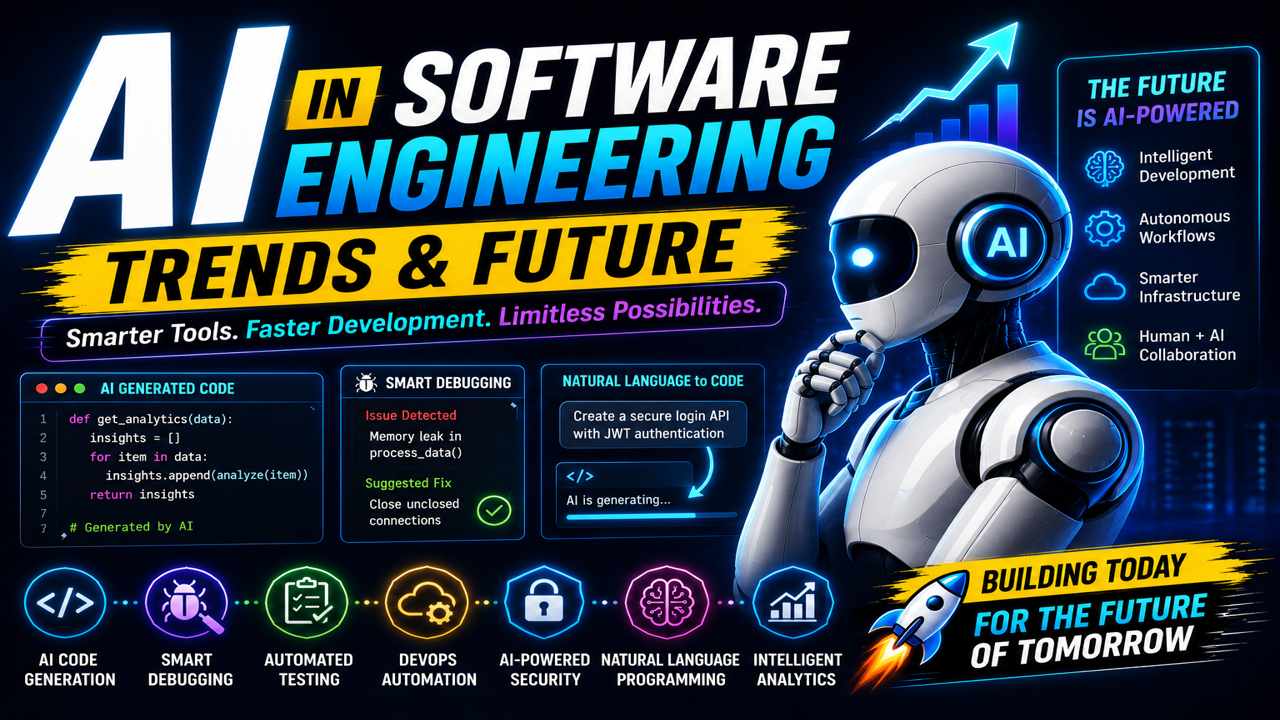
Artificial Intelligence is no longer an experimental layer in software engineering—it is becoming part of the core development infrastructure. From intelligent code generation and automated debugging to AI-assisted testing and DevOps optimization, AI is transforming how software is designed, built, deployed, and maintained.
In 2026, software engineering is entering a new phase where AI is deeply integrated into every stage of the development lifecycle. Teams adopting AI-driven workflows are building products faster, reducing operational overhead, and scaling engineering productivity in ways that were previously impossible.
The future of software engineering is not about developers competing against AI. It’s about developers learning how to collaborate with increasingly intelligent systems.
The Evolution of AI in Software Engineering
AI adoption in software engineering began with relatively simple tools:
- Syntax prediction
- Autocomplete suggestions
- Basic static analysis
Today, AI systems can:
- Generate full applications
- Detect vulnerabilities
- Refactor large codebases
- Automate workflows
- Explain complex logic
- Optimize infrastructure decisions
The shift has been rapid because software development naturally contains:
- Repetitive patterns
- Structured logic
- Predictable workflows
These characteristics make engineering highly compatible with machine learning systems.
AI-Powered Code Generation Is Becoming Standard
One of the biggest trends in software engineering is AI-driven code generation.
Modern AI coding platforms can generate:
- APIs
- Frontend components
- Database schemas
- Authentication systems
- Test suites
- Deployment scripts
This dramatically reduces the time required to move from idea to implementation.
Instead of starting projects from scratch, developers increasingly use AI-generated foundations and refine them based on business requirements.
Platforms like AiTenzo are helping developers streamline:
- Code generation
- Debugging
- Optimization
- Workflow automation
inside unified AI-powered development environments.
The result is faster software delivery with reduced repetitive engineering effort.
AI-Assisted Debugging Is Replacing Manual Troubleshooting
Debugging has historically consumed a massive portion of engineering time.
AI systems are now capable of:
- Analyzing stack traces
- Detecting recurring error patterns
- Suggesting optimized fixes
- Predicting runtime issues
This transforms debugging from:
- Manual investigation
into:
- Intelligent issue resolution
Developers no longer need to spend hours searching forums or documentation for common problems. AI assistants can provide contextual debugging support directly inside development workflows.
This trend is significantly improving engineering productivity.
Natural Language Programming Is Emerging
One of the most disruptive trends in software engineering is natural language-driven development.
Developers can now describe features such as:
“Build a secure REST API with JWT authentication and admin roles.”
AI systems can generate a working implementation almost instantly.
This changes programming from:
- Manual instruction writing
to:
- Intent-driven development
Natural language programming lowers the barrier between ideas and implementation.
It also accelerates:
- MVP development
- Internal tooling
- SaaS prototyping
- Automation systems
AI Is Reshaping Developer Roles
As AI handles repetitive implementation tasks, the role of software engineers is evolving.
Developers are increasingly focusing on:
- Architecture decisions
- Product strategy
- System scalability
- AI orchestration
- Security oversight
- Workflow optimization
The value of developers is shifting away from repetitive typing and toward:
- Engineering judgment
- Creative problem-solving
- Strategic thinking
This is creating a new category of engineers who specialize in managing AI-assisted workflows effectively.
AI in DevOps and Infrastructure Automation
AI is rapidly transforming DevOps operations.
Modern AI systems can:
- Predict infrastructure failures
- Optimize cloud resource allocation
- Detect anomalies in real time
- Automate deployment decisions
- Recommend scaling strategies
AI-driven DevOps pipelines reduce:
- Downtime
- Deployment risks
- Manual monitoring overhead
This allows engineering teams to operate systems more efficiently at scale.
AI-powered infrastructure management is becoming especially important for:
- SaaS platforms
- Cloud-native systems
- High-traffic applications
Automated Testing Is Becoming Smarter
Testing is another area being heavily transformed by AI.
AI can now:
- Generate unit tests automatically
- Predict edge cases
- Identify risky code changes
- Detect unstable behaviors
Traditional testing workflows often require repetitive manual effort.
AI-assisted testing improves:
- Coverage
- Speed
- Accuracy
while reducing engineering overhead.
The future of QA is becoming increasingly autonomous.
AI Is Improving Software Security
Security is one of the most critical areas where AI is making a major impact.
AI systems can:
- Detect vulnerabilities early
- Analyze risky dependencies
- Identify insecure coding patterns
- Predict potential attack vectors
This allows developers to shift security left—addressing problems during development rather than after deployment.
As cyber threats become more advanced, AI-assisted security systems are becoming essential for modern engineering teams.
Enterprise Software Engineering Is Becoming AI-Native
Large organizations are rapidly integrating AI into:
- Internal development platforms
- CI/CD pipelines
- Code review systems
- Monitoring tools
- Workflow automation
Enterprise teams using AI-assisted engineering are seeing:
- Faster release cycles
- Reduced operational costs
- Improved code consistency
- Higher developer productivity
AI-native development environments are becoming a competitive advantage rather than an experimental innovation.
Multi-Agent AI Systems Are the Next Big Shift
One of the biggest emerging trends is the rise of multi-agent AI engineering systems.
Instead of a single assistant handling one task, multiple AI agents may soon collaborate to:
- Write code
- Review implementations
- Test functionality
- Optimize performance
- Deploy applications
This creates semi-autonomous software engineering workflows.
Future development environments may include:
- AI architects
- AI testers
- AI security reviewers
- AI deployment managers
working together alongside human developers.
The Future of Software Engineering Will Be Hybrid
AI is not replacing software engineers entirely.
Complex engineering still requires:
- Human creativity
- Strategic reasoning
- Ethical decision-making
- Product understanding
- Long-term planning
However, the balance of work is changing dramatically.
Future software engineering workflows will likely involve:
- AI handling repetitive execution
- Humans guiding architecture and strategy
The developers who thrive will be those who understand how to:
- Collaborate with AI systems
- Validate AI-generated outputs
- Optimize AI-assisted workflows
rather than resist the shift entirely.
AI Will Continue Expanding Across the Entire Development Lifecycle
The most important trend is not just smarter coding assistants—it’s the expansion of AI across every layer of software engineering.
From:
- Planning
- Development
- Testing
- Security
- Deployment
- Monitoring
- Optimization
AI is becoming deeply embedded into engineering operations.
The future of software engineering is moving toward:
- Faster iteration
- Intelligent automation
- AI-assisted collaboration
- Higher engineering leverage
And as AI systems continue improving, the difference between traditional development teams and AI-native engineering teams will become increasingly significant.