Software development has always involved a surprising amount of repetition. While developers often focus on solving complex engineering problems, a large portion of daily work still consists of writing boilerplate code, fixing recurring bugs, formatting files, creating APIs, and handling repetitive implementation patterns.
In 2026, Artificial Intelligence is transforming this reality.
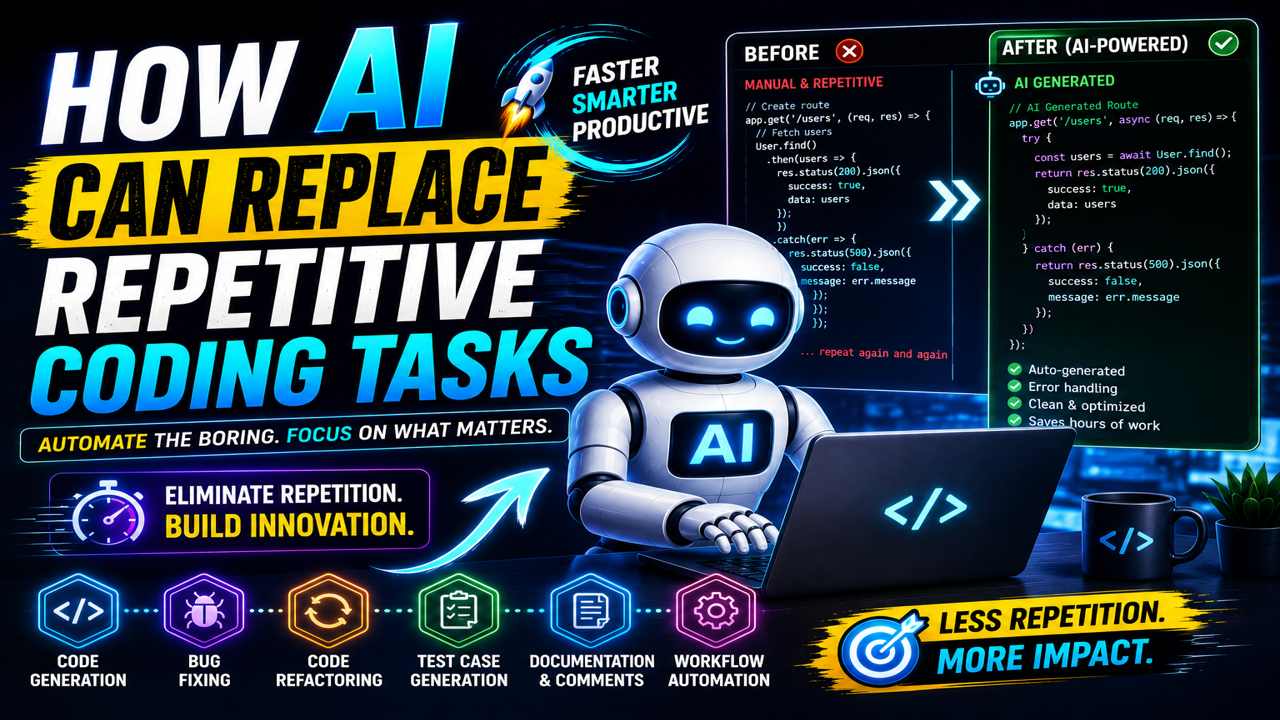
AI coding systems are now capable of automating many repetitive development tasks that once consumed hours of manual effort. Instead of spending time rewriting similar structures across projects, developers can now delegate predictable workflows to AI and focus on higher-value engineering work.
This shift is not about replacing developers entirely. It’s about eliminating low-leverage tasks so developers can work faster, smarter, and more creatively.
Why Repetitive Coding Slows Development
Modern software engineering involves much more than building unique features.
Developers repeatedly perform tasks such as:
- Creating CRUD operations
- Writing API endpoints
- Generating validation logic
- Building authentication systems
- Refactoring duplicate code
- Formatting files
- Writing tests
- Updating configurations
These tasks are important, but they often:
- Consume development time
- Increase fatigue
- Create inconsistencies
- Slow product delivery
The more projects developers manage, the more repetitive work accumulates.
AI is solving this problem through intelligent automation.
AI Understands Coding Patterns
One reason AI is highly effective at repetitive coding is because repetitive work follows predictable structures.
AI models are trained on massive programming datasets and can recognize:
- Common framework patterns
- Standard architectures
- Frequently repeated logic
- Development best practices
This allows AI systems to generate consistent implementations quickly.
Instead of manually creating the same structure dozens of times, developers can now describe intent and let AI handle execution.
Automating Boilerplate Code
Boilerplate code is one of the biggest productivity killers in development.
Developers repeatedly write:
- Route definitions
- Controllers
- Database models
- Form validation
- Middleware
- Configuration files
AI can generate these instantly.
For example, developers can prompt AI to:
“Create a REST API with authentication and validation using Node.js and MongoDB.”
AI systems can generate:
- Folder structures
- API endpoints
- Database schemas
- Validation logic
- Authentication middleware
within seconds.
This drastically reduces setup time for new projects.
AI-Powered Code Generation Speeds Up Development
AI coding assistants now go far beyond simple autocomplete.
Modern platforms can generate:
- Full components
- Backend logic
- SQL queries
- Reusable functions
- Frontend layouts
- API integrations
This changes development workflows significantly.
Instead of starting from scratch, developers begin with an AI-generated foundation and refine it based on business requirements.
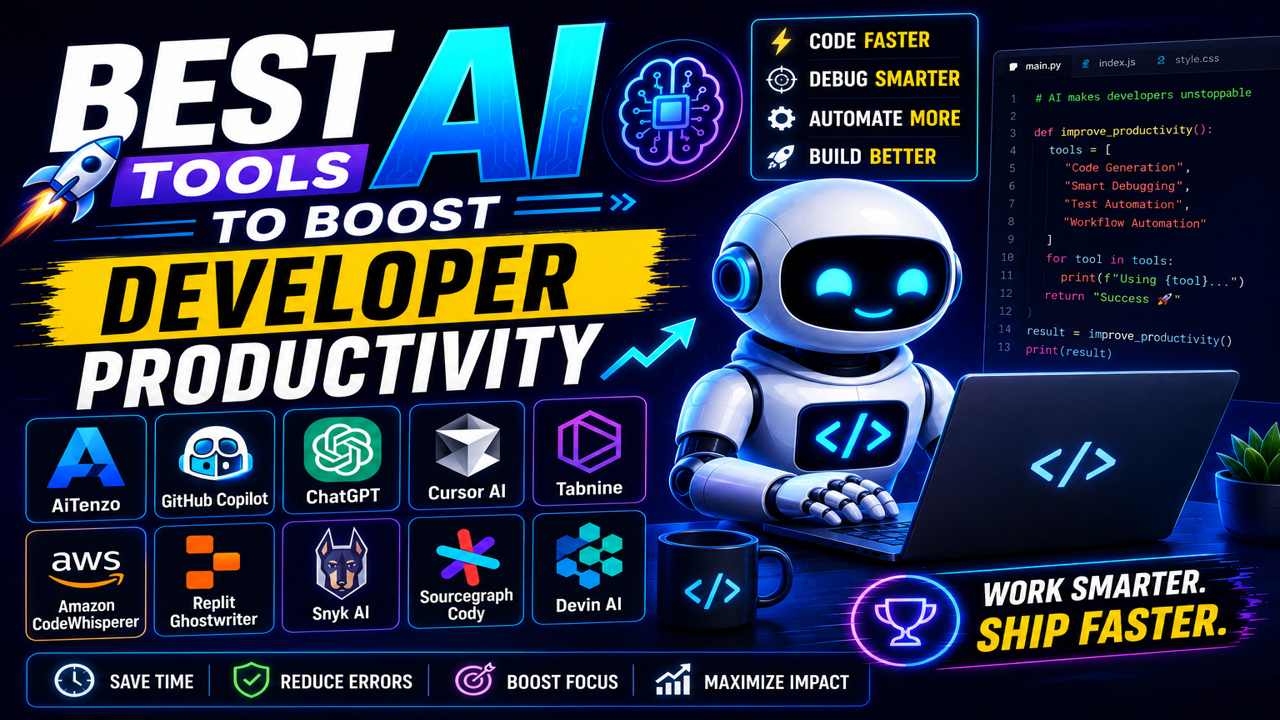
Platforms like AiTenzo are helping developers automate code generation, debugging, optimization, and workflow tasks from a single environment.
The result is:
- Faster implementation
- Less repetitive typing
- Improved workflow consistency
Repetitive Debugging Is Being Automated
Many bugs developers encounter are not unique.
Common issues include:
- Syntax errors
- Undefined variables
- Dependency conflicts
- API mismatches
- Null reference problems
AI systems can now:
- Detect these patterns instantly
- Suggest fixes automatically
- Explain why the issue occurred
This dramatically reduces debugging time.
Instead of manually tracing every issue, developers can rely on AI-assisted diagnostics and focus on solving higher-level engineering problems.
AI Can Automate Code Refactoring
Refactoring large codebases manually is tedious and time-consuming.
AI tools are becoming increasingly effective at:
- Cleaning duplicate code
- Improving readability
- Optimizing performance
- Standardizing structures
- Updating deprecated syntax
This is especially valuable for:
- Legacy projects
- Large enterprise applications
- Scaling SaaS platforms
AI-powered refactoring improves maintainability while reducing technical debt.
Test Generation Is Becoming AI-Driven
Writing tests is critical but often repetitive.
AI can now generate:
- Unit tests
- Integration tests
- Mock data
- Edge-case scenarios
based on existing code context.
This increases testing coverage while reducing manual workload.
Developers can spend more time validating business logic rather than manually creating repetitive test structures.
AI Reduces Context Switching
One of the hidden productivity problems in development is constant context switching.
Developers frequently move between:
- IDEs
- Documentation
- Stack Overflow
- GitHub issues
- Error logs
AI coding assistants reduce this friction by bringing contextual assistance directly into the workflow.
Developers can:
- Ask questions inside the IDE
- Generate explanations instantly
- Resolve issues without leaving the editor
This helps maintain focus and improves coding momentum.
Natural Language Programming Is Accelerating Automation
A major shift happening right now is natural language-driven development.
Developers can describe functionality such as:
“Build a dashboard with user authentication and analytics charts.”
AI can generate a working implementation rapidly.
This makes repetitive development tasks even faster because developers no longer need to manually define every low-level detail.
The interaction model is changing from:
- Manual implementation
to:
- AI-guided orchestration
AI Improves Workflow Consistency
Human developers naturally introduce inconsistencies over time:
- Different naming conventions
- Varying code structures
- Repeated mistakes
- Uneven formatting
AI systems help standardize:
- Coding patterns
- Project structures
- Formatting styles
- Implementation logic
This creates cleaner, more maintainable codebases across teams.
Consistency becomes easier to maintain at scale.
Developers Can Focus on High-Value Work
The real advantage of AI automation is not simply speed.
It’s freeing developers to focus on:
- Architecture decisions
- Product strategy
- Performance optimization
- Security
- User experience
- Innovation
AI handles repetitive execution while humans focus on strategic engineering.
This creates a more efficient development model overall.
Will AI Fully Replace Coding Jobs?
AI is replacing repetitive coding tasks—not the entire role of developers.
Software engineering still requires:
- Creativity
- Critical thinking
- Business understanding
- System design
- Scalability planning
AI cannot independently manage complex product decisions or fully understand business objectives.
The future is not:
- AI replacing developers
It’s:
- Developers using AI to eliminate low-value work and increase productivity dramatically.
The Rise of AI-Augmented Development Teams
Development teams are increasingly adopting AI-native workflows.
This includes:
- AI-generated implementations
- Automated testing
- Smart debugging
- Continuous optimization
- Workflow automation
Teams using AI effectively are:
- Shipping products faster
- Reducing operational overhead
- Scaling development more efficiently
The competitive advantage is becoming significant.
Repetitive Coding Is Becoming Optional
The biggest shift happening in software development today is this:
Developers no longer need to spend most of their time on repetitive implementation work.
AI systems are transforming programming from:
- Manual execution
into:
- Intelligent collaboration
The developers who adapt to AI-assisted workflows early will gain:
- Faster delivery cycles
- Better productivity
- Cleaner workflows
- More time for innovation
And as AI continues evolving, repetitive coding tasks will increasingly become automated by default rather than manually handled every day.