Application development has traditionally been a time-intensive process involving planning, coding, debugging, testing, deployment, and continuous optimization. Developers often spend weeks or even months building features that require repetitive implementation work before reaching a production-ready stage.
In 2026, Artificial Intelligence is dramatically changing this workflow.
AI-powered development tools are helping developers build applications faster by automating repetitive coding tasks, accelerating debugging, simplifying UI generation, improving testing workflows, and reducing the overall complexity of software engineering.
The result is not just faster development—it’s a complete shift in how modern applications are built.
The Traditional App Development Bottleneck
Building an application involves many layers:
- Frontend development
- Backend logic
- Database architecture
- API integrations
- Authentication systems
- Testing workflows
- Deployment configurations
Much of this work includes repetitive implementation patterns that consume large amounts of engineering time.
Developers frequently rewrite:
- Authentication systems
- CRUD operations
- Validation logic
- API structures
- Dashboard components
- Deployment pipelines
These tasks are necessary but rarely innovative.
AI is helping eliminate this repetitive engineering overhead.
AI Accelerates Code Generation
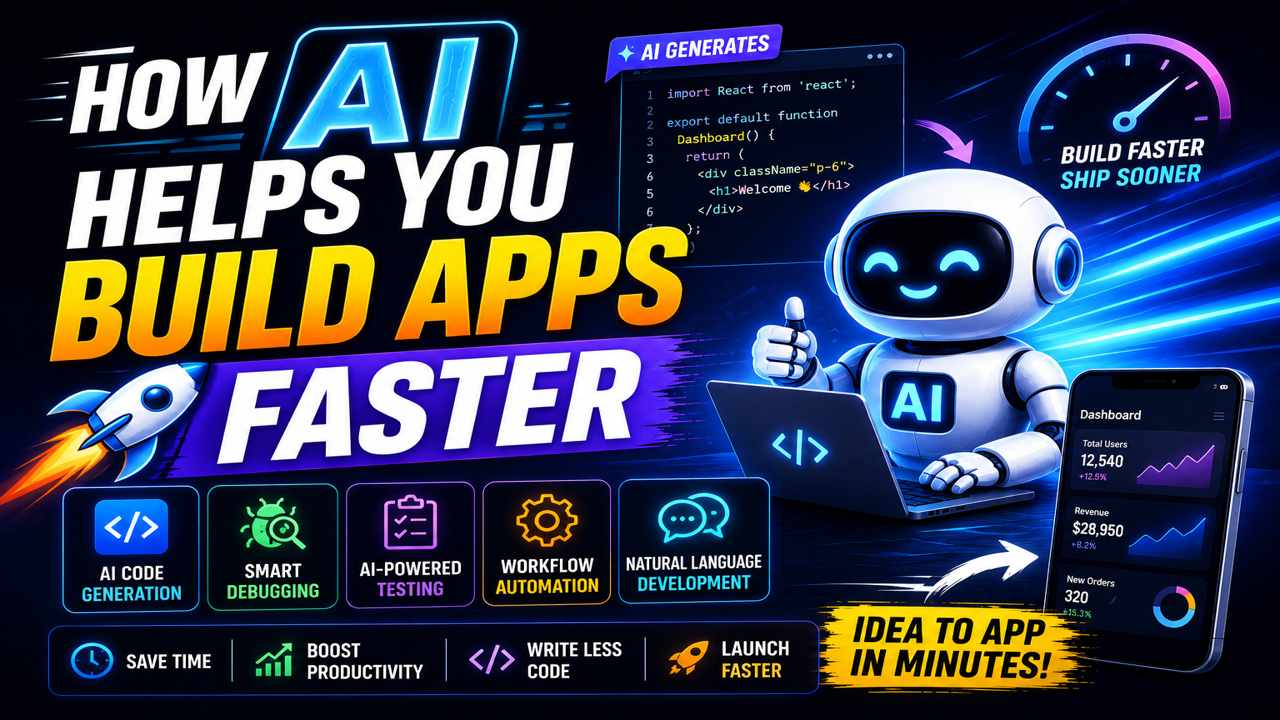
One of the biggest ways AI speeds up app development is through intelligent code generation.
Modern AI systems can generate:
- Frontend components
- APIs
- Database schemas
- Authentication flows
- Form validation
- Routing structures
within seconds.
Instead of manually building every foundational layer, developers can generate working implementations quickly and customize them based on business requirements.
For example, developers can describe:
“Create a SaaS dashboard with user login, subscription plans, and analytics charts.”
AI tools can produce the initial architecture almost instantly.
This dramatically reduces project setup time.
Faster MVP Development
Startups and SaaS founders are increasingly using AI to accelerate MVP (Minimum Viable Product) development.
Traditional MVP creation often requires:
- UI design
- Backend setup
- Database modeling
- Authentication integration
- API development
AI can automate much of this process.
This allows teams to:
- Validate ideas faster
- Launch products quickly
- Test markets earlier
- Reduce development costs
Platforms like AiTenzo help streamline app development workflows by combining:
- AI code generation
- Smart debugging
- Workflow automation
- Code optimization
inside a unified development environment.
This reduces friction across the entire app development lifecycle.
AI Reduces Repetitive Frontend Work
Frontend development often includes repetitive UI implementation.
Developers repeatedly create:
- Forms
- Navigation systems
- Dashboards
- Tables
- Authentication screens
- Responsive layouts
AI tools can now generate reusable UI structures automatically.
This speeds up:
- React development
- Vue applications
- Angular projects
- Mobile app interfaces
Developers spend less time building standard layouts and more time improving user experience.
Backend Development Is Becoming Faster
Backend engineering includes many repetitive workflows:
- API creation
- Database operations
- Authentication handling
- Middleware setup
- Validation logic
AI systems can automate much of this implementation.
Developers can generate:
- REST APIs
- GraphQL endpoints
- Database queries
- Authentication middleware
without manually writing every function from scratch.
This significantly accelerates backend development for:
- SaaS products
- Internal tools
- Automation systems
- Enterprise applications
AI Makes Debugging Faster
Debugging has traditionally been one of the slowest parts of software development.
AI-assisted debugging tools can now:
- Analyze stack traces instantly
- Detect logical errors
- Suggest fixes automatically
- Explain why issues occur
This reduces time spent:
- Searching documentation
- Investigating repetitive bugs
- Troubleshooting manually
Developers can resolve issues faster and maintain workflow momentum.
AI-powered debugging is becoming one of the biggest productivity advantages in modern engineering.
Natural Language Development Is Changing Everything
One of the most transformative shifts in app development is natural language programming.
Developers can now describe functionality such as:
“Build an eCommerce app with payment integration and admin dashboard.”
AI systems can generate:
- Initial architecture
- API structures
- UI components
- Database models
almost instantly.
This reduces the gap between:
- Ideas
- and
- Working applications
Natural language-driven development is making app creation significantly faster and more accessible.
AI Improves Testing Workflows
Testing is essential for application reliability, but writing tests manually can slow development.
AI can now:
- Generate unit tests
- Predict edge cases
- Create mock data
- Detect unstable logic
This improves testing coverage while reducing repetitive manual effort.
Developers can spend more time refining application behavior instead of manually creating repetitive testing scenarios.
Faster Deployment and DevOps Automation
AI is also accelerating deployment workflows.
Modern AI-powered DevOps systems can:
- Automate deployment pipelines
- Detect infrastructure anomalies
- Optimize cloud resources
- Predict scaling requirements
This reduces operational complexity during application launches.
AI-assisted DevOps is especially valuable for:
- SaaS platforms
- Cloud-native applications
- High-traffic systems
where rapid deployment and scalability matter significantly.
AI Helps Developers Stay in Flow
One major reason development slows down is constant context switching.
Developers frequently move between:
- IDEs
- Documentation
- Stack Overflow
- GitHub issues
- Tutorials
AI assistants reduce this disruption by providing contextual support directly inside the workflow.
Developers can:
- Ask questions instantly
- Generate explanations
- Solve errors without leaving the editor
This helps maintain focus and coding momentum.
AI Enables Smaller Teams to Build Bigger Products
AI is changing team dynamics dramatically.
Small teams can now achieve productivity levels that once required much larger engineering departments.
AI helps smaller teams:
- Build faster
- Automate repetitive work
- Reduce operational overhead
- Scale development more efficiently
This is especially important for:
- Startups
- Indie developers
- SaaS founders
- Remote engineering teams
AI is becoming a force multiplier for modern software development.
App Development Is Becoming AI-Native
The future of app development is moving toward AI-native workflows.
This includes:
- AI-generated code
- Automated debugging
- Smart testing
- AI-assisted architecture
- Workflow automation
The role of developers is evolving from:
- Writing every line manually
to:
- Guiding intelligent systems strategically
This shift is increasing development speed while reducing repetitive engineering effort.
The Future of Building Apps Will Be Faster Than Ever
AI is fundamentally transforming how applications are built.
Developers who adopt AI-assisted workflows are:
- Launching products faster
- Iterating more efficiently
- Automating repetitive tasks
- Scaling applications more effectively
The biggest advantage is no longer simply technical skill alone.
It’s the ability to combine:
- Human creativity
- with
- AI-powered execution
to build software at a speed that traditional workflows cannot match anymore.