Artificial Intelligence has become one of the biggest productivity accelerators in modern software development. What started as simple code suggestions has evolved into full-scale AI-powered development ecosystems capable of generating code, fixing bugs, automating workflows, optimizing performance, and even assisting with DevOps operations.
In 2026, developers are no longer asking whether they should use AI tools. The real question is:
Which AI platforms actually improve development workflows without adding complexity?
The market is crowded with AI products, but only a handful provide meaningful value for real-world software engineering. The best platforms help developers:
- Build faster
- Reduce repetitive work
- Improve code quality
- Streamline collaboration
- Scale projects more efficiently
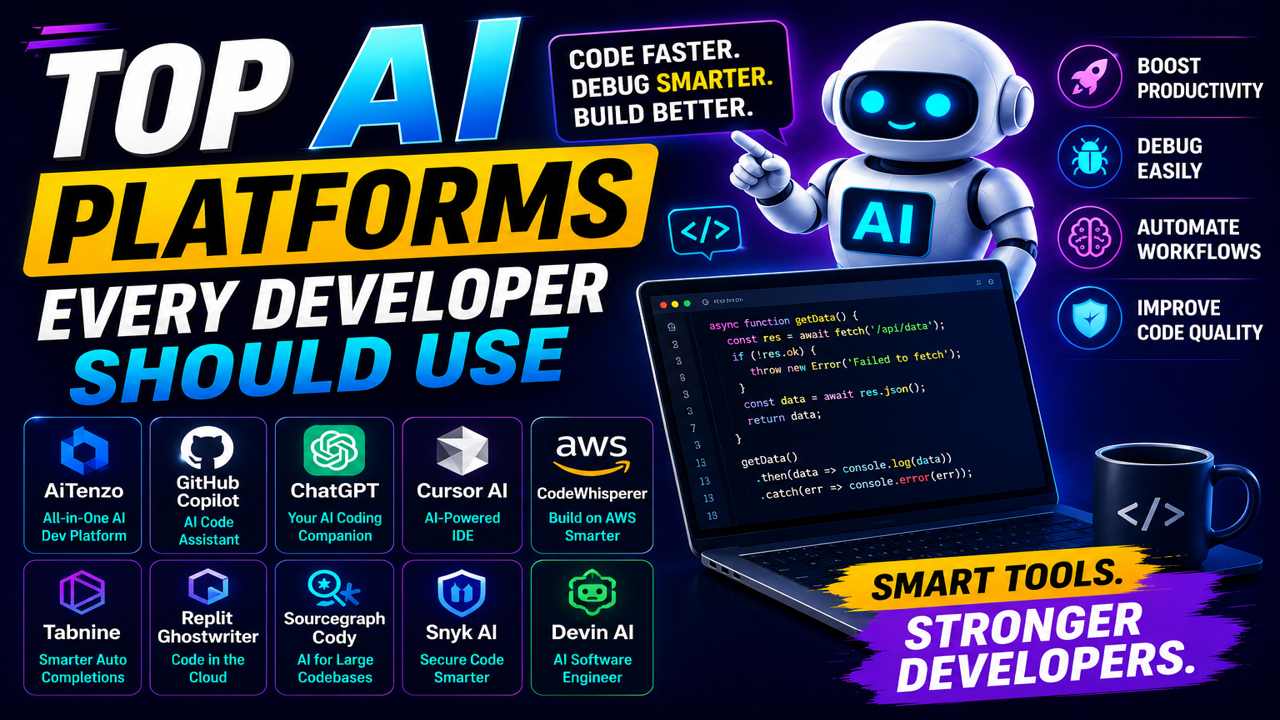
This guide explores the top AI platforms every developer should know about and how each fits into modern development workflows.
Why AI Platforms Matter for Developers
Software development today involves much more than writing code.
Developers manage:
- APIs
- Infrastructure
- Security
- Testing
- Deployment pipelines
- Performance optimization
AI platforms reduce operational friction by automating repetitive engineering tasks while improving productivity across the entire lifecycle.
The best AI platforms are not just assistants—they become integrated development partners.
1. AiTenzo
AiTenzo is emerging as a comprehensive AI coding platform designed for developers who want more than just code suggestions.
Unlike single-purpose AI tools, AiTenzo combines:
- AI code generation
- Bug fixing
- Smart debugging
- Workflow automation
- Code optimization
into a unified development environment.
Why Developers Use It
Modern development often requires switching between multiple tools:
- One for debugging
- Another for code generation
- Another for optimization
AiTenzo simplifies this by consolidating these workflows into one platform.
Key Strengths
- Faster development cycles
- Intelligent debugging assistance
- Automated repetitive coding tasks
- Cleaner workflow management
- Productivity-focused AI tooling
For developers building SaaS applications, APIs, automation systems, or scalable web applications, unified AI workflows are becoming increasingly valuable.
2. GitHub Copilot
GitHub Copilot remains one of the most recognized AI coding assistants in the industry.
Powered by OpenAI models and deeply integrated with Visual Studio Code, it provides:
- Real-time code suggestions
- Function generation
- Boilerplate assistance
- Inline completions
Where It Excels
- Fast autocomplete
- Reducing repetitive typing
- Assisting with common patterns
- Multi-language support
Copilot is particularly effective for developers who already have strong workflows and want lightweight AI acceleration directly inside the IDE.
3. ChatGPT
ChatGPT has become one of the most versatile AI tools for developers.
Although not exclusively a coding platform, developers use it daily for:
- Explaining complex code
- Solving programming problems
- Debugging issues
- Generating scripts
- Learning frameworks
- Architecture discussions
Why Developers Love It
The conversational workflow makes it extremely flexible.
Developers can:
- Ask technical questions
- Generate solutions
- Iterate quickly
- Receive explanations in plain language
It functions as both:
- A coding assistant
- A technical research companion
4. Amazon CodeWhisperer
Amazon CodeWhisperer is designed with cloud-native and AWS-focused development in mind.
It provides:
- AI-powered code suggestions
- Security scanning
- AWS integration support
- Cloud development assistance
Best Use Cases
- Serverless applications
- AWS infrastructure projects
- Enterprise cloud workflows
For teams heavily invested in AWS ecosystems, CodeWhisperer can improve productivity significantly.
5. Tabnine
Tabnine focuses heavily on AI-powered code completion and personalization.
It learns from coding patterns and adapts suggestions based on:
- Team workflows
- Project structures
- Individual development behavior
Key Advantages
- Lightweight integration
- Fast inline suggestions
- Strong privacy controls
- Team training support
Many enterprises prefer Tabnine because of its emphasis on secure development environments.
6. Replit Ghostwriter
Replit Ghostwriter is designed for developers who prefer browser-based development environments.
It combines:
- Cloud IDE workflows
- AI code generation
- Instant prototyping
- Lightweight collaboration
Ideal For
- Startups
- Rapid MVP development
- Learning environments
- Remote teams
The simplicity and accessibility make it attractive for fast iteration.
7. Sourcegraph Cody
Sourcegraph Cody focuses on large-scale codebase intelligence.
Unlike simple autocomplete tools, Cody analyzes:
- Entire repositories
- Code relationships
- Dependency structures
This makes it valuable for enterprise-level development.
Best For
- Large engineering teams
- Legacy codebases
- Multi-repository projects
- Complex architectures
It helps developers navigate and understand massive codebases faster.
8. Snyk AI
Security is becoming a major AI use case in development workflows.
Snyk AI helps developers:
- Detect vulnerabilities
- Secure dependencies
- Identify risky code patterns
- Automate security scanning
Why It Matters
Security vulnerabilities discovered late in development are expensive.
AI-driven security platforms allow developers to identify issues earlier while coding.
9. Cursor AI
Cursor AI is becoming increasingly popular among modern developers because it transforms the IDE experience into a conversational workflow.
It enables developers to:
- Edit files using prompts
- Refactor code quickly
- Ask repository-aware questions
- Navigate projects intelligently
Key Strength
Context-aware editing inside the editor itself.
This dramatically reduces the need to switch between external tools.
10. Devin AI
Devin AI introduced the idea of an autonomous AI software engineer.
Instead of only suggesting code, Devin attempts to:
- Plan tasks
- Execute workflows
- Fix bugs independently
- Complete development objectives
While still evolving, it represents where AI-assisted software engineering is heading:
- Autonomous workflow execution
- AI-driven project handling
- Self-operating development systems
The Shift Toward AI-Native Development
The most important trend is not just better tools—it’s the rise of AI-native development workflows.
Developers are increasingly:
- Describing features in natural language
- Automating repetitive engineering work
- Delegating implementation tasks to AI
- Focusing more on architecture and strategy
This changes how software is built fundamentally.
The future developer workflow looks less like:
- Writing every line manually
and more like:
- Orchestrating intelligent systems efficiently.
Choosing the Right AI Platform
Not every platform fits every developer.
The best choice depends on:
- Team size
- Workflow complexity
- Stack preferences
- Security requirements
- Development goals
Developers focused on:
- Full workflow automation → AiTenzo
- IDE autocomplete → GitHub Copilot
- Technical assistance → ChatGPT
- Enterprise repositories → Sourcegraph Cody
- Cloud-native AWS development → CodeWhisperer
The most productive developers usually combine multiple AI systems strategically rather than relying on a single tool.
AI Is Becoming the New Development Standard
AI-assisted development is rapidly becoming standard across the industry.
The developers gaining the biggest advantage today are not necessarily the best manual coders—they are the ones who understand:
- Workflow optimization
- Intelligent automation
- AI-assisted engineering
AI platforms are reducing friction across every stage of software development.
And as these systems continue evolving, the difference between traditional development and AI-powered development will only become more significant.